By: Doris C. Dumlao
Philippine Daily Inquirer
5:57 pm | Friday, July 22nd, 2011
MANILA, Philippines—Housing developer Vista Land and Lifescapes Inc. announced on Friday the appointment of Manuel Paolo Villar, the eldest son of company founder Sen. Manuel Villar, as its new president and chief executive officer.
Vista Land disclosed to the Philippine Stock Exchange on Friday that the younger Villar had replaced Benjamarie Therese Serrano, who will assume a senior executive position in Fine Properties, Inc., the investment holding company of the Villar Family, while remaining a non-executive director in Vista Land.
The 35-year-old Villar has held various senior positions in the Vista Land group since 2001, two years after graduating from the Wharton School of the University of Pennsylvania with a Bachelor of Science in Economics and Bachelor of Applied Science in 1999.
Prior to his appointment as president and CEO, Villar was chief financial officer of the company and was instrumental in the public listing of the property developer on the Philippine Stock Exchange. He spearheaded all major fund-raising activities for Vista Land over the last few years, after heading the corporate planning group of Crown Asia Properties, Inc., a subsidiary of Vista Land.
Before returning to the Philippines in 2001 to join the Vista Land group, Villar worked for McKinsey and Co. in the United States.
The company also announced the appointment of Ricardo Tan, Jr. as chief financial officer, taking over the post vacated by Villar. Prior to this appointment, Tan was senior vice president for finance of the company. A finance professional, Tan had previously worked for the International Finance group of the Department of Finance as well as other private corporations.
The Villar-led Vista Land sells house-and-lots under the Brittany, Crown Asia, Lessandra and Camella brands.
Sunday, July 24, 2011


Broad vision catapults lit major to exec position
FIRST JOB
By: Abigail L. HoPhilippine Daily Inquirer
11:08 pm | Saturday, July 23rd, 2011
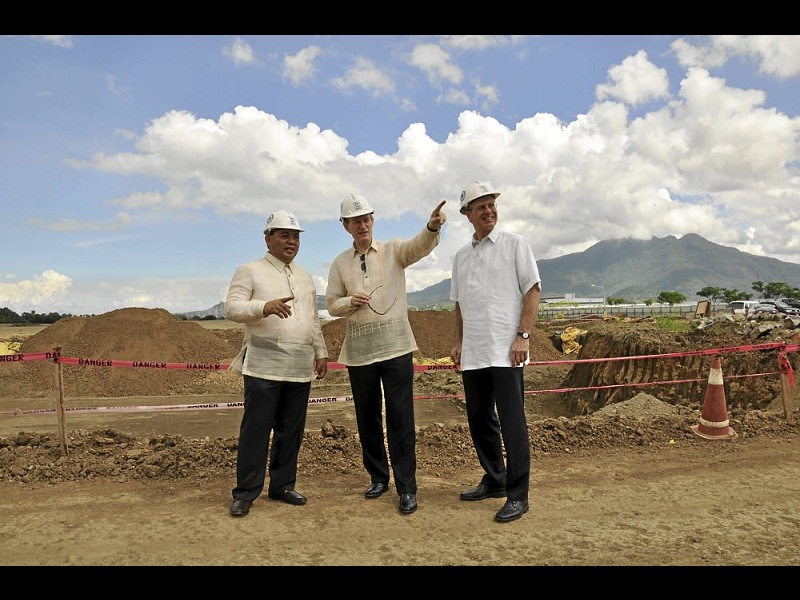
JOHN with company executives visiting the construction site in Tanauan, Batangas where Nestlé Philippines’ newest factory will rise.
An English literature and geography major from the University of Durham in England, all he had when he started his career in the 80s was a broad vision of what he wanted to do with his life.
“I did not see myself then as an executive. I had a broad vision of where I wanted to go. I’ve always wanted to work internationally, and that’s what I’m doing now. You shouldn’t have a too-specific idea of where you want to be, as that will restrict you,” he shares in an interview with SundayBiz.
Entering the world of business as a management trainee for a multinational company after earning his degree, he had no qualms about being unable to deliver what the job required of him, despite his lack of hard-core business know-how.
“I have no business qualifications, aside from my years of experience in business now. There weren’t that many business schools when I was growing up,” he relates. “But education is not so much what you study but how you study.”
Starting from the bottom
Although he did not take a business course in college, Miller did have some exposure to business—at least the manual labor side of it—when he was growing up.
His father was in the frozen food business and he helped re-arrange freezers from time to time. He also took on summer jobs during school breaks, the first one being as a shelver at a liquor store in England.
“I earned 33 pence (around P22.50, using present-day conversion rates) an hour, which wasn’t very much. It was a vacation job when I was a teenager,” he recalls. “I also worked in a silkscreen printing factory. That was before I started university.”
Today, after more than three decades of working for various companies, most of which were multinationals, he no longer had to do any heavy lifting, shelving, or freezer re-arranging. The challenges he had to face, however, were no less easier to deal with.
Adapting to diverse cultures

JOHN repainting a Gawad Kalinga house at Baseco 2.
He was first assigned to Asia in 1990 and had, since then, made the rounds of almost all countries in the region.
Prior to his posting here in the Philippines, he was chair and chief executive of Nestlé Indochina, where he held fort in Thailand, and was managing director of Nestlé Singapore Pte. Ltd. prior to that.
He also served as senior vice president for Danone’s biscuit business in Asia Pacific, a board member at Britannia Industries Ltd. in India, and senior vice president for Unilever Corp.’s personal care business in Africa, Middle East, and Turkey.
During his earlier days with Unilever, he held various senior management positions that got him assigned to the Czech Republic, Indonesia, Malaysia, the Slovak Republic, and the United Arab Emirates.
Even after all those years in Asia Pacific, he admits that he still has a few surprises when he came to work in the Philippines.
“I’ve been visiting the Philippines for more than 20 years, but this is my first time to work here. The Philippines is fascinating because it has so many latent characteristics. It’s a very stimulating country. It has a diverse culture—more than many other Asean countries that I’ve been to,” he relates.
It was mainly the people that set the country apart.
“In working with Filipinos, I’ve seen the passion of the people. The level of emotion, driven by passion and commitment, is extraordinary in the Philippines. That’s part of our success,” he says.
Philippine difference
Now on his third year in the country, Miller says he was still fascinated by the passion of the Filipinos, both those on the factory floors and those on the management side.
Working with such an able team—the best and the brightest in the industry—made his job so much easier, he says.
“During the recent visit of our CEO (Paul Bulcke), he was greatly impressed. He said I got the easiest job. The things I do here are fairly limited: I choose where to invest, I pick people to occupy certain positions, and I manage the external environment,” he relates.
“We have an extremely able team. We attract the best and the brightest people, and that makes my job a lot easier. We’re a company of individual leaders, but we work as a seamless team.”
“As one of the many expats working here, we constantly learn about what works and what doesn’t work. We learn how to adapt. Here at Nestlé Philippines, I believe I learn more than I contribute,” he adds.
Apart from the people, he adds that another thing unique about his Philippine experience was the fact that no two days were ever completely alike.
“I don’t have a typical day. No two days are the same. Here, it’s not like in the West where we like being structured and we know how our days will go. Many things happen that you can’t predict. It’s a combination of knowing what you need to do and the things that just happen. That makes my job such an exciting one,” he says.
This made his work life so much more enjoyable—something that was particularly important, especially since there was no big division between his work life and personal life.
During days when he could get some non-work-related things done, he relates that he favored reading biographies, fiction, and business books, as well as running marathons. The last marathon he ran, however, was 10 years ago when his daughter Sophie was born.
Despite his hectic work schedule, he says he always had time for his family. Many times, his Malaysian wife Ying was also involved with the company, working with the wives of the other executives.
“We’re a tight-knit family (at Nestlé Philippines). I know that family’s very important in the Philippines,” he says. “In Nestlé, we involve everybody. We’re a family company.”
Saturday, July 23, 2011
ICTSI gets P1.7B from share sale
Philippine Daily Inquirer
8:58 pm | Friday, July 22nd, 2011
International Container Terminal Services Inc. (ICTSI) is selling treasury shares accumulated during the financial crisis in 2009 to raise fresh capital that can bankroll the group’s aggressive expansion locally and overseas.
In a disclosure Friday, the listed company said it approved the sale of about 31.24 million common shares held by subsidiary ICTSI Warehousing Inc. to an institutional investor for P55.45 each.
The shares worth P1.7 billion were crossed on the same day it was announced. ICTSI said it expected to be paid by early next week. The company declined to disclose the identity of the buyer.
While the price at which the shares were sold seemed like a discount over ICTSI’s P58.30 close on Thursday, it was still a significant premium over the stock’s one-year low of P31 each.
“The proceeds of the sale will be used by the ICTSI group to fund its ongoing capital expenditure program and for general corporate purposes,” the company told the local bourse. “We are just monetizing our treasury shares,” said ICTSI treasurer Rafael Consing.
CLSA Ltd. acted as the transaction’s sole bookrunner and sale placing agent.
ICTSI is one of the world’s biggest port operators, with 23 different projects in 17 countries around the world. Last year, the company posted a net profit of $98.3 million, up 79 percent year-on-year due to the recovery in global trade coupled with the increase in revenues from new projects.
In 2011, ICTSI plans to nearly triple its capital spending to $356 million from $125 million in 2010, skewed mainly for the development of new facilities in Latin America.
In the Philippines, ICTSI operates the Manila International Container Terminal, the Bauan Terminal in Batangas, Makar Wharf in General Santos, Sasa Wharf in Davao, the New Container Terminal (NCT) 1 in Subic and the Mindanao Container Terminal in Misamis Oriental. Paolo G. Montecillo
8:58 pm | Friday, July 22nd, 2011
International Container Terminal Services Inc. (ICTSI) is selling treasury shares accumulated during the financial crisis in 2009 to raise fresh capital that can bankroll the group’s aggressive expansion locally and overseas.
In a disclosure Friday, the listed company said it approved the sale of about 31.24 million common shares held by subsidiary ICTSI Warehousing Inc. to an institutional investor for P55.45 each.
The shares worth P1.7 billion were crossed on the same day it was announced. ICTSI said it expected to be paid by early next week. The company declined to disclose the identity of the buyer.
While the price at which the shares were sold seemed like a discount over ICTSI’s P58.30 close on Thursday, it was still a significant premium over the stock’s one-year low of P31 each.
“The proceeds of the sale will be used by the ICTSI group to fund its ongoing capital expenditure program and for general corporate purposes,” the company told the local bourse. “We are just monetizing our treasury shares,” said ICTSI treasurer Rafael Consing.
CLSA Ltd. acted as the transaction’s sole bookrunner and sale placing agent.
ICTSI is one of the world’s biggest port operators, with 23 different projects in 17 countries around the world. Last year, the company posted a net profit of $98.3 million, up 79 percent year-on-year due to the recovery in global trade coupled with the increase in revenues from new projects.
In 2011, ICTSI plans to nearly triple its capital spending to $356 million from $125 million in 2010, skewed mainly for the development of new facilities in Latin America.
In the Philippines, ICTSI operates the Manila International Container Terminal, the Bauan Terminal in Batangas, Makar Wharf in General Santos, Sasa Wharf in Davao, the New Container Terminal (NCT) 1 in Subic and the Mindanao Container Terminal in Misamis Oriental. Paolo G. Montecillo
Friday, July 15, 2011
SEC registration soon available at LandBank
07/15/2011 | 05:14 PM
Entrepreneurs and investors seeking convenient ways to register their incorporation documents may soon do so at branches of the Land Bank of the Philippines (LandBank).
Finance Secretary Cesar Purisima said the agreement the Securities and Exchange Commission (SEC) and LandBank signed Friday will help improve the investment climate in the country by cutting the time it takes to process business registration papers.
The agreement expands the limited reach of the SEC which has only six offices.
“The ultimate goal is to make the registration process or the opening of businesses in the country available through the Internet. With the advances in technology now, nothing really stops us from making that happen except our willingness to try to have better uses of technology," Purisima said.
LandBank president Gilda Pico said that the government bank’s 326 branches nationwide will accept and pre-process the requirements and collect the filing fee when its interface with the SEC is fully-functional next September.
“We want to cut the processing time because that is where the problem is. They can also save on transportation costs. We are offering this as an option but if they want to go directly to the SEC, they can," Pico said.
The Department of Trade and Industry already has an online registration system for business name registration.
In Metro Manila, the local governments of Quezon City, Manila, Marikina and Mandaluyong have begun to streamline their business registration and permits issuance with a P16-million project funding support from the International Finance Corporation.
Entrepreneurs and investors seeking convenient ways to register their incorporation documents may soon do so at branches of the Land Bank of the Philippines (LandBank).
Finance Secretary Cesar Purisima said the agreement the Securities and Exchange Commission (SEC) and LandBank signed Friday will help improve the investment climate in the country by cutting the time it takes to process business registration papers.
The agreement expands the limited reach of the SEC which has only six offices.
“The ultimate goal is to make the registration process or the opening of businesses in the country available through the Internet. With the advances in technology now, nothing really stops us from making that happen except our willingness to try to have better uses of technology," Purisima said.
LandBank president Gilda Pico said that the government bank’s 326 branches nationwide will accept and pre-process the requirements and collect the filing fee when its interface with the SEC is fully-functional next September.
“We want to cut the processing time because that is where the problem is. They can also save on transportation costs. We are offering this as an option but if they want to go directly to the SEC, they can," Pico said.
The Department of Trade and Industry already has an online registration system for business name registration.
In Metro Manila, the local governments of Quezon City, Manila, Marikina and Mandaluyong have begun to streamline their business registration and permits issuance with a P16-million project funding support from the International Finance Corporation.
Thursday, July 14, 2011
Philippine Stock Exchange to extend trading hours starting October
By: Doris C. Dumlao
Philippine Daily Inquirer
12:00 pm | Thursday, July 14th, 2011
MANILA, Philippines—The Philippine Stock Exchange has finalized plans to extend trading hours beginning October 2011, in a bid to attract more investor interest and prepare for cross-border trading with Southeast Asian neighbors.
The PSE disclosed on Thursday that its board had approved extending the trading hours from 9 a.m. to 1 p.m. from the current trading hours from 9:30 am to 12:10 pm.
By January 1, 2012, the trading hours will be extended further into the afternoon but with a lunch break in between. The morning session will be 9:30 a.m. to 12 noon while the afternoon session will be 1:30 to 3:30 p.m.
With the local stocks index hitting record highs, PSE chair Jose Pardo said in a recent interview that it’s timely to implement longer trading hours for the local bourse to be able to “identify with the rest of the world.”
“The countdown with Asean is fast approaching. We’re looking at March next year to begin that process of integration,” Pardo said.
The PSE had approved a resolution to revive longer trading hours in 2008 but this was shelved due to the unfavorable economic conditions at that time. At that time, global commodity prices were skyrocketing, thereby hurting the Philippines, a net importer of crude oil and rice. This was followed by the Wall Street-epicentered financial crisis that shook up the rest of the world in 2009.
The policy to extend trading hours was revived as the new PSE board believed this would help boost liquidity in the local market.
Philippine Daily Inquirer
12:00 pm | Thursday, July 14th, 2011
MANILA, Philippines—The Philippine Stock Exchange has finalized plans to extend trading hours beginning October 2011, in a bid to attract more investor interest and prepare for cross-border trading with Southeast Asian neighbors.
The PSE disclosed on Thursday that its board had approved extending the trading hours from 9 a.m. to 1 p.m. from the current trading hours from 9:30 am to 12:10 pm.
By January 1, 2012, the trading hours will be extended further into the afternoon but with a lunch break in between. The morning session will be 9:30 a.m. to 12 noon while the afternoon session will be 1:30 to 3:30 p.m.
With the local stocks index hitting record highs, PSE chair Jose Pardo said in a recent interview that it’s timely to implement longer trading hours for the local bourse to be able to “identify with the rest of the world.”
“The countdown with Asean is fast approaching. We’re looking at March next year to begin that process of integration,” Pardo said.
The PSE had approved a resolution to revive longer trading hours in 2008 but this was shelved due to the unfavorable economic conditions at that time. At that time, global commodity prices were skyrocketing, thereby hurting the Philippines, a net importer of crude oil and rice. This was followed by the Wall Street-epicentered financial crisis that shook up the rest of the world in 2009.
The policy to extend trading hours was revived as the new PSE board believed this would help boost liquidity in the local market.
Wednesday, July 06, 2011
Xavier University puts up retail center
Posted on June 29, 2011 09:22:16 PM
CAGAYAN DE ORO -- Xavier University, a Jesuit-run institution in Mindanao, has partnered with Pryce Corp. to erect a shopping mall inside the campus that will feature students’ business experiments.
The retail center, once completed by September, will feature 13 leasable stalls where students with the best business ideas will be allowed to try out their plans under an incubation setup.
Accepted applicants would get seed capital, consultancy services, business linkages, technology development, and marketing assistance, among other privileges.
Details on lease rates to be collected from student entrepreneurs have yet to be finalized.
The student mall will be accessible to the general public.
Based on the designs of HS Busgano Architect Studio, the leasable spaces will be primarily housed on the first floor of the structure. The mezzanine will meanwhile house a business center, which would be equipped with computers and telephone and Internet connections. A training/conference room would also be located in the mezzanine.
Some of the stalls will have window displays with one reserved for College of Agriculture students who have been selling their commodities at the school’s dry pond. There will be three collapsible modules measuring four square meters that come on top of the stalls.
JCL Construction, Inc. is putting up the structure between the College of Agriculture building and Science Center.
As such, the structure would double as the school’s newest portal, decongesting its two pedestrian entrances.
Xavier University has produced some of the city’s most successful entrepreneurs. Many small and medium enterprises in the city, such as Butcher’s Best BBQ and, most recently, Malunggay Pastel started out as student projects.
Xavier University was founded in 1933, soon after, it became Ateneo de Cagayan. Upon becoming Mindanao’s first university, it was renamed ‘Xavier’ after the Jesuit saint. -- Al Gerard G. dela Cruz
Accepted applicants would get seed capital, consultancy services, business linkages, technology development, and marketing assistance, among other privileges.
Details on lease rates to be collected from student entrepreneurs have yet to be finalized.
The student mall will be accessible to the general public.
Based on the designs of HS Busgano Architect Studio, the leasable spaces will be primarily housed on the first floor of the structure. The mezzanine will meanwhile house a business center, which would be equipped with computers and telephone and Internet connections. A training/conference room would also be located in the mezzanine.
Some of the stalls will have window displays with one reserved for College of Agriculture students who have been selling their commodities at the school’s dry pond. There will be three collapsible modules measuring four square meters that come on top of the stalls.
JCL Construction, Inc. is putting up the structure between the College of Agriculture building and Science Center.
As such, the structure would double as the school’s newest portal, decongesting its two pedestrian entrances.
Xavier University has produced some of the city’s most successful entrepreneurs. Many small and medium enterprises in the city, such as Butcher’s Best BBQ and, most recently, Malunggay Pastel started out as student projects.
Xavier University was founded in 1933, soon after, it became Ateneo de Cagayan. Upon becoming Mindanao’s first university, it was renamed ‘Xavier’ after the Jesuit saint. -- Al Gerard G. dela Cruz
Sunday, July 03, 2011
‘Be flexible to change directions when opportunity comes’
By: Tina Arceo-Dumlao
Philippine Daily Inquirer
1:58 am | Sunday, July 3rd, 2011
 The road toward achieving life’s goals is not always straight. More often than not, it is marked by long detours, deep potholes, seemingly insurmountable roadblocks and discouraging dead ends.
In the case of Mahendra Gursahani, chief executive officer of Standard Chartered Bank’s Philippine operations, the path he took was long and winding, initially taking him to the world of accounting before finally leading him to his true calling in the field of banking and finance.
Gursahani tells SundayBiz in an e-mail interview that he studied accounting and economics in the university because he thought then that he wanted to be in accountancy. He got his first taste of it when he was 20 years old, working as a trainee accountant in London, and thought he was hooked.
“I earned enough then to keep body and soul together with a little left over for the occasional visit to the pub,” Gursahani recalls. “I became entirely self-sufficient financially from that time.”
He trained and worked hard for five years in London to qualify to be an accountant.
However, as fate would have it, when he did qualify in London with the Institute of Chartered Accountants in England and Wales, he decided that he did not really want to be a Chartered accountant after all.
He wanted to be a banker instead.
“My belief is that at times, you have to go with your current desires and be flexible enough to change directions if the opportunity presents itself. Too much planning for the future can become exhausting and counterproductive,” says Gursahani, who is turning 55 this October.
He went headlong into his new field and picked up as many lessons and advice as he could through the many posts he occupied on his way up the corporate ladder.
It did not take long for his superiors to realize that they had a high flyer in their midst, one with great potential to handle great responsibilities.
Focus and determination to enhance his innate abilities were traits he learned growing up in an upper class family in India.
“My father was on the board of Unilever in India so my upbringing was somewhat privileged. Our life was disciplined, focused and principled, and conversations around the dinner table were around education and the business and political world,” Gursahani says.
“I learnt from an early stage to not just be financially responsible but also to be sensitive to those who have to struggle more. My parents themselves sacrificed tremendously to educate my brother and I through the best schools. Education was a cornerstone of our value system.”
 He considers his father one of the many role models who have all helped put him where he is today.
“There is no single mentor, but many along the way whom I have respected and learned from. One must be a keen observer of people and be willing to accept that you can never stop learning,” he says.
“Know your strengths and use them to create advantages for yourself and your company. Surround yourself with people whose strengths might be your weaknesses. This way, you can build fully complementary and contributing teams,” Gursahani adds.
Gursahani adds that in his experience, having an open mind is essential to one’s career as it alerts a person to opportunities for growth that can come up unexpectedly.
“I never consciously planned my career, but I have always had an open mind, knowing only that the broader my experience, the better banker I could be. It is because of this that I have experienced a broad range of roles across multiple geographies,” Gursahani says.
Before coming to the Philippines in June last year, Mahendra was Standard Chartered’s chief financial officer for the Middle East, Africa, Europe and Americas, and based in Dubai.
He was also concurrently senior executive officer for Dubai International Financial Center, overseeing all general management responsibilities.
Before landing in Dubai, he held positions in Sydney, Singapore and London.
“I have never looked at my career as a way up the ladder but rather as an opportunity to become more and more self-aware and to contribute in different ways as one evolves. I have few regrets,” he adds.
Gursahani says that in his career, the biggest lesson he has learned is always “be yourself” and not try to be different just to please other people.
For the Australian national, that is not the way to get ahead.
“Pretending to be something else is way too stressful,” he says.
He offers more words of advice for the executive wanting to also succeed in the corporate world.
“Build teams that can make the environment professional and also fun. Respect others for what they can bring and above all treat people as you would like to be treated. Fair but firm would be the hallmark of a good leader,” Gursahani says.
At this point in his life, Gursahani can actually afford to just retire and enjoy the rest of his life with his family. But retirement is not yet on the horizon as he still wants to move forward professionally and personally, especially in the Philippines, which is considered a major market of the London-based bank.
“I want to continue to contribute to my bank, all the staff members and society, in whatever little way that I can,” Gursahani says, “At the moment, I am entirely focused on seizing the new opportunities that the Philippine economy is presenting to us and positioning our bank to be a partner in the country’s journey to economic success.”
“I want Standard Chartered Bank here in the Philippines to be recognized as an institution that provides great service to our customers, innovative solutions to our clients and gives back to local communities,” Gursahani says.
“Being the first foreign bank to have been established here in 1872, Standard Chartered proudly considers itself a partner of the Filipino in nation-building.”
“I am very optimistic about the Philippines and consider myself privileged to be joining at this time when the country’s future looks very promising,” he says.
Philippine Daily Inquirer
1:58 am | Sunday, July 3rd, 2011
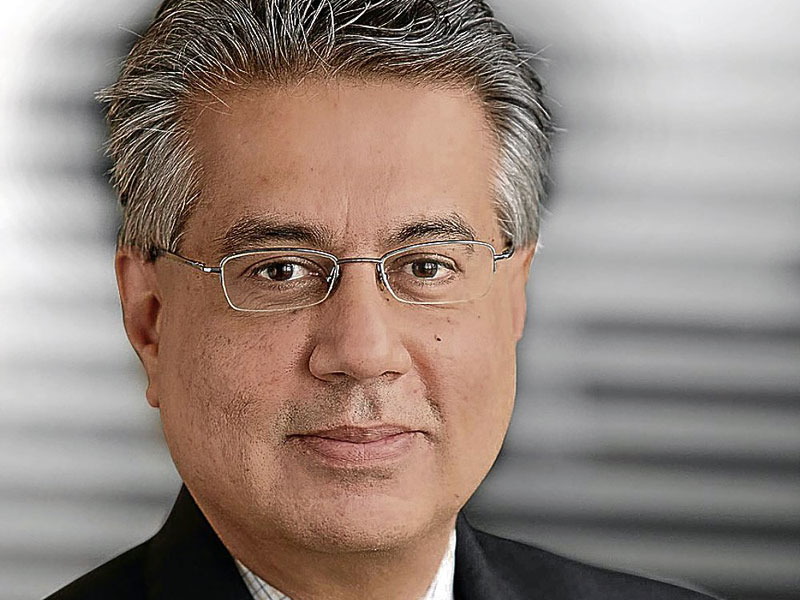
MAHENDRA Gursahani, CEO of Standard Chartered in the Philippines
In the case of Mahendra Gursahani, chief executive officer of Standard Chartered Bank’s Philippine operations, the path he took was long and winding, initially taking him to the world of accounting before finally leading him to his true calling in the field of banking and finance.
Gursahani tells SundayBiz in an e-mail interview that he studied accounting and economics in the university because he thought then that he wanted to be in accountancy. He got his first taste of it when he was 20 years old, working as a trainee accountant in London, and thought he was hooked.
“I earned enough then to keep body and soul together with a little left over for the occasional visit to the pub,” Gursahani recalls. “I became entirely self-sufficient financially from that time.”
He trained and worked hard for five years in London to qualify to be an accountant.
However, as fate would have it, when he did qualify in London with the Institute of Chartered Accountants in England and Wales, he decided that he did not really want to be a Chartered accountant after all.
He wanted to be a banker instead.
“My belief is that at times, you have to go with your current desires and be flexible enough to change directions if the opportunity presents itself. Too much planning for the future can become exhausting and counterproductive,” says Gursahani, who is turning 55 this October.
He went headlong into his new field and picked up as many lessons and advice as he could through the many posts he occupied on his way up the corporate ladder.
It did not take long for his superiors to realize that they had a high flyer in their midst, one with great potential to handle great responsibilities.
Focus and determination to enhance his innate abilities were traits he learned growing up in an upper class family in India.
“My father was on the board of Unilever in India so my upbringing was somewhat privileged. Our life was disciplined, focused and principled, and conversations around the dinner table were around education and the business and political world,” Gursahani says.
“I learnt from an early stage to not just be financially responsible but also to be sensitive to those who have to struggle more. My parents themselves sacrificed tremendously to educate my brother and I through the best schools. Education was a cornerstone of our value system.”
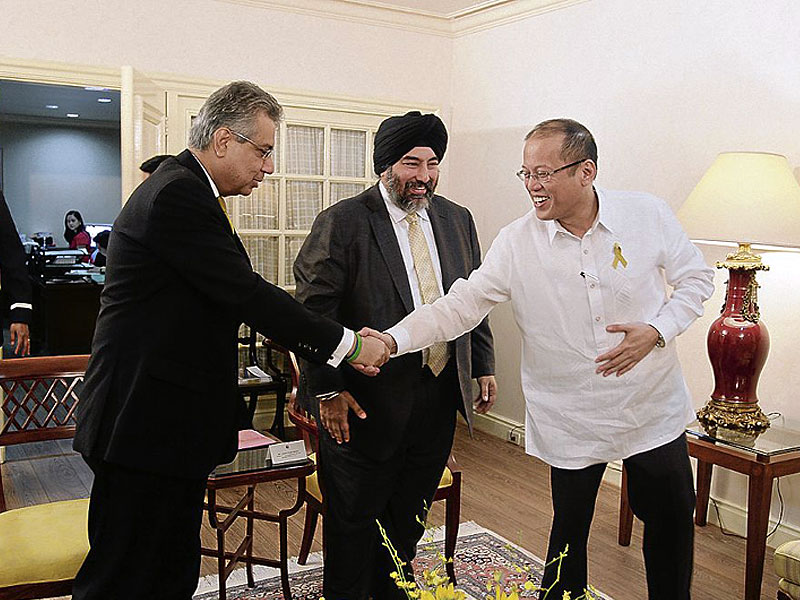
MAHENDRA Gursahani (left) accompanies Jaspal Singh Bindra, Standard Chartered chief executive officer for Asia (center), during a courtesy call to
President Benigno Aquino.
President Benigno Aquino.
“There is no single mentor, but many along the way whom I have respected and learned from. One must be a keen observer of people and be willing to accept that you can never stop learning,” he says.
“Know your strengths and use them to create advantages for yourself and your company. Surround yourself with people whose strengths might be your weaknesses. This way, you can build fully complementary and contributing teams,” Gursahani adds.
Gursahani adds that in his experience, having an open mind is essential to one’s career as it alerts a person to opportunities for growth that can come up unexpectedly.
“I never consciously planned my career, but I have always had an open mind, knowing only that the broader my experience, the better banker I could be. It is because of this that I have experienced a broad range of roles across multiple geographies,” Gursahani says.
Before coming to the Philippines in June last year, Mahendra was Standard Chartered’s chief financial officer for the Middle East, Africa, Europe and Americas, and based in Dubai.
He was also concurrently senior executive officer for Dubai International Financial Center, overseeing all general management responsibilities.
Before landing in Dubai, he held positions in Sydney, Singapore and London.
“I have never looked at my career as a way up the ladder but rather as an opportunity to become more and more self-aware and to contribute in different ways as one evolves. I have few regrets,” he adds.
Gursahani says that in his career, the biggest lesson he has learned is always “be yourself” and not try to be different just to please other people.
For the Australian national, that is not the way to get ahead.
“Pretending to be something else is way too stressful,” he says.
He offers more words of advice for the executive wanting to also succeed in the corporate world.
“Build teams that can make the environment professional and also fun. Respect others for what they can bring and above all treat people as you would like to be treated. Fair but firm would be the hallmark of a good leader,” Gursahani says.
At this point in his life, Gursahani can actually afford to just retire and enjoy the rest of his life with his family. But retirement is not yet on the horizon as he still wants to move forward professionally and personally, especially in the Philippines, which is considered a major market of the London-based bank.
“I want to continue to contribute to my bank, all the staff members and society, in whatever little way that I can,” Gursahani says, “At the moment, I am entirely focused on seizing the new opportunities that the Philippine economy is presenting to us and positioning our bank to be a partner in the country’s journey to economic success.”
“I want Standard Chartered Bank here in the Philippines to be recognized as an institution that provides great service to our customers, innovative solutions to our clients and gives back to local communities,” Gursahani says.
“Being the first foreign bank to have been established here in 1872, Standard Chartered proudly considers itself a partner of the Filipino in nation-building.”
“I am very optimistic about the Philippines and consider myself privileged to be joining at this time when the country’s future looks very promising,” he says.
Saturday, June 25, 2011
Henry Sy tops Philippines' 40 richest: Forbes
Posted at 06/23/2011 9:02 AM | Updated as of 06/23/2011 1:44 PM
MANILA, Philippines - Eighty-six-year-old mall magnate Henry Sy remains the richest man in the Philippines while port operator Enrique Razon Jr. joined the elite billionaires' list this year, according to the annual listing conducted by Forbes Magazine.
The annual listing said the country's 40 richest men are now worth a collective $34 billion, up from last year's $22.8 billion. Forbes said a 27% uptick in the stock exchange's composite index lifted the fortunes of the country’s richest to an all time high.
It said there are now 11 billionaires in the Philippines this year, compared to only 5 last year. Forbes compiles the list based on information from individuals, stock exchanges, public documents and analysts as well as estimates of the privately held assets of the businessmen. The minimum net worth to make the list this year increased to $85 million, up from $50 million previously.
For the fourth year in a row, Sy remained the Philippines' richest man with a net worth of $7.2 billion, up from $5 billion last year. Forbes said shares in SM Investments, the Sy family's largest asset, is up nearly 40%. Sy's listed property developer Belle Corp. is expected to open its first casino in Manila in 2012.
Second on the list is tycoon Lucio Tan with an estimated $2.8 billion in assets, up from $2.1 billion in 2010. The 77-year-old tycoon owns a bevy of businesses which include Fortune Tobacco, Asia Brewery, and Hong-Kong based Eton Properties.
Third on the list is JG Summit founder John Gokongwei Jr. The 83-year-old is worth $2.4 billion, up from his net worth last year of $1.5 billion.
Fourth on the list is Alliance Global Group's Andrew Tan with an estimated net worth of $2 billion from last year's $1.2 billion.
Fifth on the list is 90-year-old construction manage David Consunji, who has an estimated net worth of $1.9 billion from last year's $715 million.
"He moved into top 5 as shares of his DMCI Holdings more than doubled in past year.
Value of Semirara Mining nearly tripled," Forbes said.
Below is the Philippines billionaires list:
1. Henry Sy $7.2 billion
2. Lucio Tan $2.8 billion
3. John Gokongwei Jr. $2.4 billion
4. Andrew Tan $2 billion
5. David Consunji $1.9 billion
6. Jaime Zobel de Ayala $1.7 billion
7. Enrique Razon Jr. $1.6 billion
8. Eduardo Cojuangco Jr. $1.4 billion
9. Roberto Ongpin $1.3 billion
10. George Ty $1.1 billion
11. Tony Tan Caktiong $1 billion
ICTSI's Razon now a billionaire
Forbes said the biggest gainer in percentage terms is former trade minister Roberto Ongpin, whose fortune soared more than fourfold to $1.3 billion. Forbes said most of that gain was thanks to an increase in his stake in listed miner Atok-Big Wedge, "though Ongpin says the company’s stock price overinflates its value."
Another newly minted billionaire is port operator Enrique Razon Jr., who saw his net worth jump to $1.6 billion from $975 million last year. His International Container Terminal Service (ICTSI) has bought controlling stakes in two terminal ports, one in India's Tamil Nadu and one in Croatia. His private company, Bloomberry, also put $350 million into a hotel complex in Manila's Bagong Nayong Pilipino Entertainment City.
Mang Inasal founder joins PH's richest
Forbes, meanwhile, listed 4 newcomers to the richest list. They are: Jose Antonio, founder of high-end property developer Century Properties; Jacinto Ng Sr., founder of biscuit maker Rebisco; and 34-year-old Edgar Sia II, founder of Mang Inasal
Mang Inasal is now the country's third largest fastfood chain, after Jollibee and Chowking. Last year, Jollibee purchased a 70% stake of Mang Inasal for $68 million, catapulting Sia's net worth to $85 million. He is ranked 40th in the Forbes list of richest Filipinos, and is the youngest in the list.
Four from 2010 list didn’t make the cut, including Lourdes Montinola, whose family owns 41% of Far Eastern University; and Jesus Tambunting, who controls Planters Development Bank. Forbes said their gains couldn’t match the stellar performance of others on the list.
The remaining names in the Philippines' 40 richest list are as follows:
12. Inigo and Mercedes Zobel $980 million
13. Emilio Yap $930 million
14. Andrew Gotianun $795 million
15. Jon Ramon Aboitiz $760 million
16. Beatrice Campos $685 million
17. Manuel Villar $620 million
18. Vivian Que Azcona $555 million
19. Robert Coyiuto Jr. $400 million
20. Mariano Tan $375 million
21. Alfonso Yuchengco $370 million
22. Enrique Aboitiz $310 million
23. Oscar Lopez $280 million
24. Jose Antonio $245 million
25. Eric Recto $200 million
26. Gilberto Duavit $190 million
27. Menardo Jimenez $185 million
28. Alfredo Ramos $180 million
29. Betty Ang $165 million
30. Felipe Gozon $163 million
31. Tomas Alcantara $160 million
32. Benjamin Romualdez $155 million
33. Wilfred Uytengsu Jr. $150 million
34. Manuel Zamora Jr. $145 million
35. Jacinto Ng Sr. $115 million
36. Frederick Dy $110 million
37. Luis Virata $100 million
38. Bienvenido Tantoco Sr. $95 million
39. Eugenio Lopez III $90 million
40. Edgar Sia II $85 million.
The annual listing said the country's 40 richest men are now worth a collective $34 billion, up from last year's $22.8 billion. Forbes said a 27% uptick in the stock exchange's composite index lifted the fortunes of the country’s richest to an all time high.
It said there are now 11 billionaires in the Philippines this year, compared to only 5 last year. Forbes compiles the list based on information from individuals, stock exchanges, public documents and analysts as well as estimates of the privately held assets of the businessmen. The minimum net worth to make the list this year increased to $85 million, up from $50 million previously.
For the fourth year in a row, Sy remained the Philippines' richest man with a net worth of $7.2 billion, up from $5 billion last year. Forbes said shares in SM Investments, the Sy family's largest asset, is up nearly 40%. Sy's listed property developer Belle Corp. is expected to open its first casino in Manila in 2012.
Second on the list is tycoon Lucio Tan with an estimated $2.8 billion in assets, up from $2.1 billion in 2010. The 77-year-old tycoon owns a bevy of businesses which include Fortune Tobacco, Asia Brewery, and Hong-Kong based Eton Properties.
Third on the list is JG Summit founder John Gokongwei Jr. The 83-year-old is worth $2.4 billion, up from his net worth last year of $1.5 billion.
Fourth on the list is Alliance Global Group's Andrew Tan with an estimated net worth of $2 billion from last year's $1.2 billion.
Fifth on the list is 90-year-old construction manage David Consunji, who has an estimated net worth of $1.9 billion from last year's $715 million.
"He moved into top 5 as shares of his DMCI Holdings more than doubled in past year.
Value of Semirara Mining nearly tripled," Forbes said.
Below is the Philippines billionaires list:
1. Henry Sy $7.2 billion
2. Lucio Tan $2.8 billion
3. John Gokongwei Jr. $2.4 billion
4. Andrew Tan $2 billion
5. David Consunji $1.9 billion
6. Jaime Zobel de Ayala $1.7 billion
7. Enrique Razon Jr. $1.6 billion
8. Eduardo Cojuangco Jr. $1.4 billion
9. Roberto Ongpin $1.3 billion
10. George Ty $1.1 billion
11. Tony Tan Caktiong $1 billion
ICTSI's Razon now a billionaire
Forbes said the biggest gainer in percentage terms is former trade minister Roberto Ongpin, whose fortune soared more than fourfold to $1.3 billion. Forbes said most of that gain was thanks to an increase in his stake in listed miner Atok-Big Wedge, "though Ongpin says the company’s stock price overinflates its value."
Another newly minted billionaire is port operator Enrique Razon Jr., who saw his net worth jump to $1.6 billion from $975 million last year. His International Container Terminal Service (ICTSI) has bought controlling stakes in two terminal ports, one in India's Tamil Nadu and one in Croatia. His private company, Bloomberry, also put $350 million into a hotel complex in Manila's Bagong Nayong Pilipino Entertainment City.
Mang Inasal founder joins PH's richest
Forbes, meanwhile, listed 4 newcomers to the richest list. They are: Jose Antonio, founder of high-end property developer Century Properties; Jacinto Ng Sr., founder of biscuit maker Rebisco; and 34-year-old Edgar Sia II, founder of Mang Inasal
Mang Inasal is now the country's third largest fastfood chain, after Jollibee and Chowking. Last year, Jollibee purchased a 70% stake of Mang Inasal for $68 million, catapulting Sia's net worth to $85 million. He is ranked 40th in the Forbes list of richest Filipinos, and is the youngest in the list.
Four from 2010 list didn’t make the cut, including Lourdes Montinola, whose family owns 41% of Far Eastern University; and Jesus Tambunting, who controls Planters Development Bank. Forbes said their gains couldn’t match the stellar performance of others on the list.
The remaining names in the Philippines' 40 richest list are as follows:
12. Inigo and Mercedes Zobel $980 million
13. Emilio Yap $930 million
14. Andrew Gotianun $795 million
15. Jon Ramon Aboitiz $760 million
16. Beatrice Campos $685 million
17. Manuel Villar $620 million
18. Vivian Que Azcona $555 million
19. Robert Coyiuto Jr. $400 million
20. Mariano Tan $375 million
21. Alfonso Yuchengco $370 million
22. Enrique Aboitiz $310 million
23. Oscar Lopez $280 million
24. Jose Antonio $245 million
25. Eric Recto $200 million
26. Gilberto Duavit $190 million
27. Menardo Jimenez $185 million
28. Alfredo Ramos $180 million
29. Betty Ang $165 million
30. Felipe Gozon $163 million
31. Tomas Alcantara $160 million
32. Benjamin Romualdez $155 million
33. Wilfred Uytengsu Jr. $150 million
34. Manuel Zamora Jr. $145 million
35. Jacinto Ng Sr. $115 million
36. Frederick Dy $110 million
37. Luis Virata $100 million
38. Bienvenido Tantoco Sr. $95 million
39. Eugenio Lopez III $90 million
40. Edgar Sia II $85 million.
Philex climbs most in 6 months on Atlas speculation
Posted at 06/25/2011 1:11 AM | Updated as of 06/25/2011 1:11 AM
MANILA, Philippines - Manuel Pangilinan's Philex Mining Corp. climbed the most in 9 months after the Philippine Star reported speculation that it would buy into Atlas Consolidated Mining and Development Corp.
Philex, the nation's biggest miner by sales, rose more than 9 percent, the most since October, closing at P23.30.
Atlas, which lost P429 million last year, climbed 20 percent in the first 4 days of the week, before getting a voluntary suspension yesterday and Monday.
It then disclosed it would sell a third of itself for $390 million dollars to what it called "targeted investors."
The funds would be used to buy out its partners in Carmen Copper Corp. for $368 million.
Several fund managers and brokers pointed to Pangilinan and two overseas groups. The Pangilinan group didn't reply when asked if that was them.
Atlas Vice President Adrian Ramos said the investors had not been finalized. Atlas has scheduled a briefing for Monday afternoon.
Big names
Just last month, Philex agreed to take up to 60 percent of Manila Mining's Kalayaan project in Surigao del Sur.
It also bought 5 percent of Manila Mining parent Lepanto Consolidated. These were just the latest acquisitions for Pangilinan.
Earlier this year, Philippine Long Distance Telephone Co., where he’s chairman, agreed to buy Digital Telecommunications Philippines Inc. from tycoon John Gokongwei.
Carmen returned to profit last year, earning P429 million compared with a P1.66 billion loss, as rising copper prices and a 60 percent increase in production almost doubled revenue. As well, the unit cut interest expense by refinancing a $100 million loan.
The refinancing came from tycoon Henry Sy's Banco de Oro, which is also arranging the Atlas transactions announced yesterday.
Atlas itself last year converted $36.5 million of loans to equity. Banco de Oro made up $25 million of that.
Philex, the nation's biggest miner by sales, rose more than 9 percent, the most since October, closing at P23.30.
Atlas, which lost P429 million last year, climbed 20 percent in the first 4 days of the week, before getting a voluntary suspension yesterday and Monday.
It then disclosed it would sell a third of itself for $390 million dollars to what it called "targeted investors."
The funds would be used to buy out its partners in Carmen Copper Corp. for $368 million.
Several fund managers and brokers pointed to Pangilinan and two overseas groups. The Pangilinan group didn't reply when asked if that was them.
Atlas Vice President Adrian Ramos said the investors had not been finalized. Atlas has scheduled a briefing for Monday afternoon.
Big names
Just last month, Philex agreed to take up to 60 percent of Manila Mining's Kalayaan project in Surigao del Sur.
It also bought 5 percent of Manila Mining parent Lepanto Consolidated. These were just the latest acquisitions for Pangilinan.
Earlier this year, Philippine Long Distance Telephone Co., where he’s chairman, agreed to buy Digital Telecommunications Philippines Inc. from tycoon John Gokongwei.
Carmen returned to profit last year, earning P429 million compared with a P1.66 billion loss, as rising copper prices and a 60 percent increase in production almost doubled revenue. As well, the unit cut interest expense by refinancing a $100 million loan.
The refinancing came from tycoon Henry Sy's Banco de Oro, which is also arranging the Atlas transactions announced yesterday.
Atlas itself last year converted $36.5 million of loans to equity. Banco de Oro made up $25 million of that.
Friday, June 17, 2011
CebuPac buys $3.8-B planes
Thursday, 16 June 2011 21:10 Lenie Lectura / Reporter
 CEBU Air Inc. has placed firm orders for 37 new Airbus units with a total list price of about $3.8 billion, or roughly P165.4 billion, making it the largest single aircraft order ever made by a Philippine carrier.
In Photo: Lance Gokongwei (right), president and CEO of Cebu Air Inc., smiles during a news conference on Thursday. (AP)
CEBU Air Inc. has placed firm orders for 37 new Airbus units with a total list price of about $3.8 billion, or roughly P165.4 billion, making it the largest single aircraft order ever made by a Philippine carrier.The low-cost carrier is going to use internal funds and tap loans from export-credit agencies to finance the payment for its orders.
“We will be using the same financing sources for our current fleet. We will try not to take in more than we can absorb, and we expect to fully fund the predelivery payments through the old means that we have, which are internal cash flow, access to export credit- agency financing and commercial lending market,” Lance Gokongwei, airline president, said at a press conference on Thursday.
The orders are composed of seven A320s and 30 A321neo aircraft, with options for a further 10 A321neos. The orders will be delivered between 2015 and 2021. These are on top of firm orders for 18 Airbus A320s to be delivered from the second half of 2011 until 2014. This increases Cebu Pacific’s total firm orders of Airbus to 55.
The airline currently utilizes 33 brand-new aircraft, 25 of which are from the Airbus A320 family and eight ATR turbo-prop aircraft. By 2021, it will more than double its fleet and triple its capacity.
Gokongwei said the new fleet will be used to mount flights to new destinations such as Australia, India and northern Japan—places which the A320s cannot reach.
The new fleet will help the company save on fuel cost by about 15 percent and reduce its unit cost per passenger, which will redound to lower fares.
“The new aircraft provides us savings in two ways. First, on the use of fuel alone, we get 15-percent savings. The second benefit is that we are ordering a larger plane, which means more capacity,” he said. Fuel covers more than 60 percent of Cebu Pacific’s operating cost.
The airline is making this investment amid the rising cost of fuel in the world market and uncertainty in the aviation sector.
“We do believe that the Philippines’ tourism agenda will add fuel to [Cebu Pacific’s] growth,” said Gokongwei. “The years 2009 and 2010 were record-breaking years for Cebu Pacific. In 2011 we intend to fully break our record further in terms of passengers carried and revenue.”
In 2010 the airline carried 10.5 million passengers. Gokongwei said Cebu Pacific intends to carry more than 12 million this year.
“The general trend in the industry is that the load factors are staying quite constant—mid- to high-80s. I would say that there is a little bit of pressure given the amount of new capacity. Overall we expect profitability this year below than last year but we expect to be one of the few airlines in the world that will remain solidly profitable despite the high fuel prices,” Gokongwei said.
According to Gokongwei, Cebu Pacific is the third-largest low-cost carrier in Asia. The largest is Air Asia of Malaysia, followed by an Indonesian carrier. “Cebu Pacific is definitely larger than Tiger Air,” he added.
Cebu Pacific will be the first airline in the country to operate the A321neo, which is a larger and longer-haul version of an A320 unit. “There is very high demand for this aircraft. We expect our regional competitors will be making the same orders,” Gokongwei said.
In Photo: Lance Gokongwei (right), president and CEO of Cebu Air Inc., smiles during a news conference on Thursday. (AP)
Subscribe to:
Posts (Atom)